Trade politics and domestic fragility test the Philippines’ property market
How global uncertainty and internal divisions are redrawing the country’s outlook
After US President Donald Trump’s infamous Liberation Day announcements, Philippine President Ferdinand Marcos Jr. visited the White House to plead for a lowering of tariffs, only to return with a meagre concession: a 1% reduction.
The theatre underscored the Philippines’ delicate position, a services powerhouse forced to perform for its powerful trading partners while contending with mounting global and domestic fragility.
In the third quarter of 2025, the Philippine economy recorded its weakest quarterly expansion in over a decade. The slowdown stemmed from global headwinds and, quite literally, wind. A series of powerful typhoons caused widespread flooding while also exposing the systemic diversion of billions of pesos intended for flood-control projects into the pockets of lawmakers.
The revelations ignited youth-led protests reminiscent of anti-graft movements elsewhere in Asia. This surge of anger rattled confidence in a political system long dominated by elite families, further polarising a body politic already strained by the power struggle between the Marcos and Duterte dynasties.
“The Q3 results point to a need for massive pump-priming from the government,” says Joey Bondoc, director of research at Colliers Philippines. “Continued slowdown in the government’s infrastructure programme will likely result in a Philippine economy grinding to a halt.”
In response, the central bank has turned aggressively accommodative, cutting benchmark interest rates five consecutive times in 2025. Yet this easing cycle has struggled to revive one of the economy’s most critical sectors: the vertical residential real estate market.
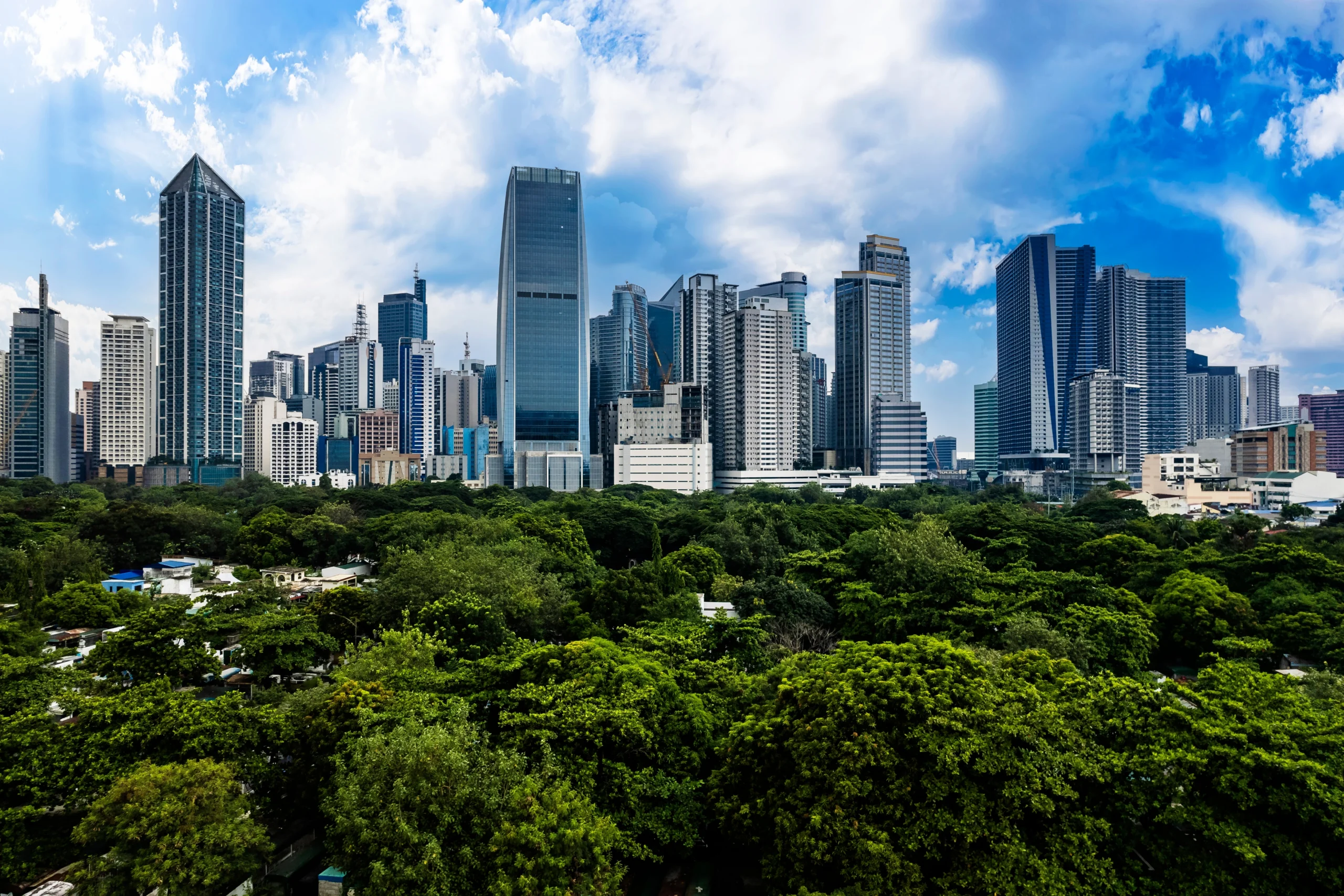
Metro Manila, the archipelago’s dense skyscraper hub, is entering 2026 firmly as a buyer’s market. New supply is tapering off, with only around 3,500 new condominiums expected to be completed annually from 2026 to 2028.
“Developers did not acquire significant parcels of developable land at the height of the pandemic, even post-pandemic,” Bondoc explains. “They did not see the demand driver in the first place to launch new projects in Metro Manila.”
Related: Inside the award-winning LIMA Estate in the Philippines
The metropolis is now saddled with more than 80,000 unsold homes, a stock that could take up to 42 months to clear, according to Leechiu Property Consultants. Demand for residential units has fallen to its weakest level in six years, according to Roy Golez, director for research at Leechiu. He cites a dual blow: buyer cancellations from those unable to meet monthly amortisations and the government’s ban on Philippine Offshore Gaming Operators (POGOs).
To stay afloat, developers have shifted their focus toward the mid-income segment. RFO (ready-for-occupancy) promotions, including heavily discounted lease-to-own schemes where rent is credited toward a future purchase, have become ubiquitous. Major players now offer plans with no obligation to buy for up to 36 months.
“The challenge for developers is to be more creative and innovative moving forward,” Bondoc says, noting that such promotions generate essential cash flow from renters to fill the financing gap left by increasingly cautious banks.
The existential question hanging over the market is one of sustainability. “Will there be fatigue around RFO promotions in Metro Manila?” Bondoc asks. “That has yet to be seen.” Underscoring this concern are the more than 30,000 RFO units that remained unsold in the metropolis as of Q3 2025.
A potential lifeline continues to flow from Overseas Filipino Workers (OFWs), who sent back USD38.3 billion in remittances in 2024, with USD29.2 billion recorded by October 2025. Filipinos based in the United States account for the largest single share.
This capital traditionally fuels the condominium market’s “sweet spot”: units priced between PHP2.5 million and PHP7 million (USD45,000 to USD125,000). “Given the upside we are seeing in the mid-income segment, we expect OFW remittances to sustain or even further fuel demand,” Bondoc says.
At the same time, compelling value is driving strong takeup of horizontal housing projects and lot-only developments outside Metro Manila. Here, buyers can acquire land at rates ranging from just PHP4,000 to PHP30,000 per square metre.
For seasoned investors, this presents a logical diversification strategy. An investor might own a condominium by one developer in the capital and then expand their portfolio with a land purchase in Bulacan or Batangas, potentially seeing price appreciation of 15% or more within a single year.

Integrated township developments continue to rise nationwide. These are emerging not only as new central business districts within Metro Manila but also as new growth corridors in Ilocos, Pampanga, Cavite, Batangas, and Davao. As competition intensifies, developers are increasingly differentiating themselves by incorporating essential institutional components such as schools.
“Instead of just saying, ‘Build and people will come,’ why not build where people live?” says Cyndy Tan Jarabata, chairperson of the PropertyGuru Philippines Property Awards judging panel and president of TAJARA Leisure & Hospitality Group Inc. “Developers are trying not to isolate people but to improve overall quality of life.”
Still, with volatile external economic conditions, there are no guarantees. As POGOs retreated from the real estate market, two new threats emerged: artificial intelligence and American protectionism.
The information technology and business process management (IT-BPM) industry, which employs nearly two million Filipinos, is under direct threat. Proposed US legislation, such as the “Keep Call Centres in America Act of 2025”, seeks to incentivise reshoring while penalising outsourcing. Combined with rapid advances in generative AI, this protectionist push could undo office booms not only in Manila but also in secondary hubs including Cebu, Pampanga, Iloilo, Davao, and Cagayan de Oro.
While the Philippines remains predominantly a services economy, its industrial sector shows early promise, albeit from a low base. Trump-era tariffs threaten to unravel this progress. The Philippines recorded a USD4.9-billion trade surplus with the US, its largest export market, in 2024.
Related: How property can be a force for good in Asia
To attract foreign capital as a counterweight, President Marcos Jr. signed Republic Act No. 12252, extending the maximum lease period for foreign investors on private land to 99 years, up from the previous 50-year cap.
“This 99-year law provides stability in terms of business policy,” Bondoc says. “It sends a signal that the Philippines is open for business.”
The goal is to move beyond basic assembly and develop a higher-value industrial ecosystem encompassing electric vehicles and semiconductors.
Central Luzon is poised to dominate this industrial push, with 870 hectares of new industrial space set for delivery from 2026 to 2028. Southern Luzon is expected to add a further 200 hectares over the same period.
Yet the promise of long-term leases collides with the Philippines’ enduring governance challenges. “The constant concern for foreign investors is the fear of the government changing the rules mid-game,” Bondoc notes.
Until we see sweeping governance reforms and a return of private investor confidence, property opportunities will not shout. They will whisper
Analysts point to the recent corporate income tax reduction legislation, designed to lure foreign direct investment but which has failed to deliver expected gains for some firms. “Changing the rules midstream is not good for the Philippines’ reputation as an investment destination,” Bondoc says.
The success of this industrial strategy ultimately depends on foreign investors’ willingness to accept the Philippines’ invitation. While the country has avoided the retaliatory trade measures faced by Canada and Mexico, its economic fortunes remain vulnerable to policy shifts in Washington.
“Starting in 2026, the government really needs to ramp up IT infrastructure spending and deliver on its public project commitments,” Bondoc says. “Prudent allocation of public funds is essential. If delays persist, we will continue to see infrastructure projects pushed back.”
Before the graft investigations erupted, the government announced an ambitious slate of 169 public-private partnership projects valued at approximately USD55 billion. While less grandiose than the infrastructure drives of his parents’ era, President Marcos Jr.’s programme, if executed faithfully, could significantly enhance land values, property prices, and rental yields across multiple sectors.
The Philippine property market and the broader economy it supports now stand at an inflexion point between external dependence and internal reform.
“Until we see sweeping governance reforms and an eventual return of private investor confidence,” Bondoc concludes, “we’re bound to see property opportunities not exactly shouting, but whispering.”
The original version of this article appeared in PropertyGuru Property Report Magazine Issue No. 194 on issuu and Magzter. Write to our editors at [email protected].
Recommended

ARES Whitepaper Volume 4: Powering communities – The catalysts of urban evolution
Fresh perspectives on sustainability, lifestyle, and design shaping the future of real estate

ARES White Paper Volume 3: The era of adaptive reinvention
Pioneering sustainable and innovative practices in urban development

ARES White Paper Volume 2: Unravelling the power of data revolution in real estate
Insights on proptech, smart cities, and sustainable development
ARES Digital White Paper Volume 1: The fundamentals of responsible building
Green and climate heroes join forces to discuss how Asia Pacific can weather the current environmental crises and the looming effects of climate change